

blog spot
THE
health hub
A collection of helpful articles & information to spread awareness through education from our staff to you

Recent public health reports confirm that measles cases are increasing again in parts of the United States. While outbreaks may not be widespread in every region, the virus’s ability to spread rapidly makes vaccination status an important topic for families in Manassas.
The most effective protection remains full immunization with the MMR vaccine.
Understanding the Risk
Measles spreads through the air and can infect individuals who were never in direct contact with a sick person. Because symptoms initially resemble a routine viral illness, measles can circulate for days before being identified.
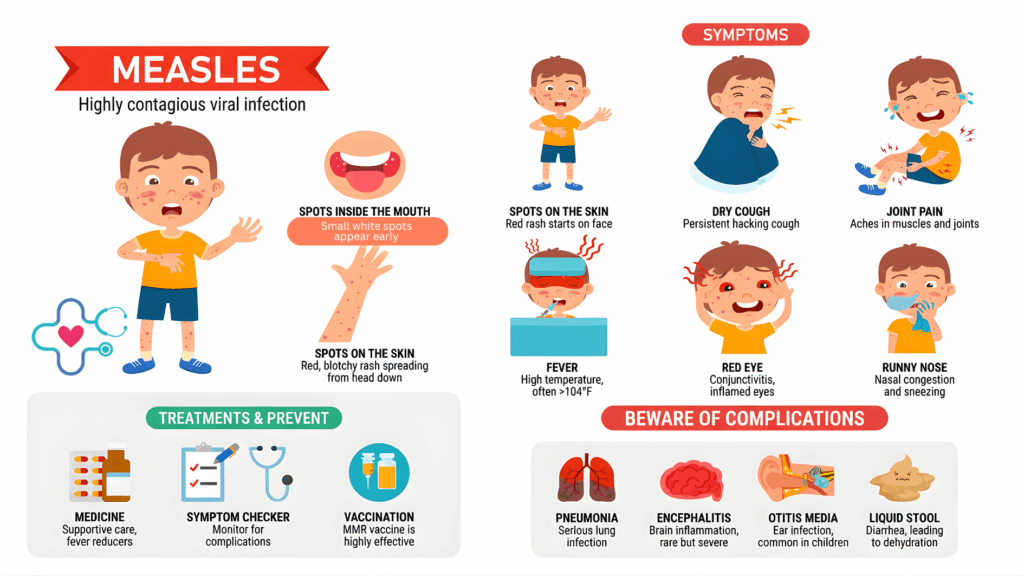
Early symptoms often include high fever, cough, runny nose, and red eyes. The rash appears later. By that point, a child may already have exposed others.
Although many children recover, complications can include pneumonia, dehydration, ear infections, and in rare cases, brain inflammation. Hospitalization is not uncommon in outbreak settings.
These risks are significantly reduced in vaccinated children.
It is common for parents to have questions about vaccine safety. The MMR vaccine has been extensively studied worldwide and continues to be monitored for safety. Side effects are generally mild and temporary, such as soreness at the injection site or a low-grade fever.
If you have concerns, discussing them with a pediatric provider allows for informed decision-making based on evidence rather than misinformation.
If your child is due for an MMR vaccine in Manassas, now is the time to confirm protection.
How Effective Is the MMR Vaccine?
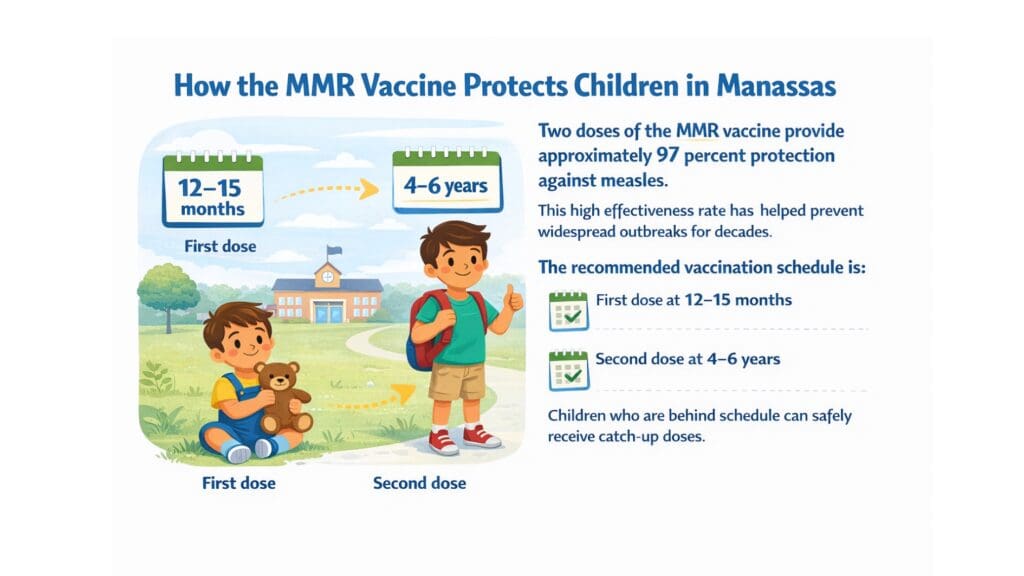
The MMR vaccine protects against measles, mumps, and rubella. For measles specifically:
• One dose is approximately 93 percent effective
• Two doses are approximately 97 percent effective
That level of protection is considered extremely strong in preventive medicine. For most children who receive both recommended doses, immunity is long-lasting.
The standard schedule recommended by the CDC is:
• First dose between 12 and 15 months
• Second dose between 4 and 6 years
If your child has received both doses, they are highly protected. If you are unsure, this is the time to review records.
Is the Measles (MMR) Vaccine Safe for Children?
Safety is often the first concern for families in Manassas considering immunizations. The MMR vaccine is one of the most extensively studied vaccines in pediatric medicine.
Before approval, vaccines must pass through:
• Pre-clinical laboratory testing
• Phase 1, 2, and 3 clinical trials
• FDA review
• Ongoing post-licensure monitoring
Even after decades of use, safety monitoring continues through national reporting systems.
The vast majority of children tolerate the MMR vaccine without issue. When side effects occur, they are generally mild and short-lived, including:
• Temporary soreness at the injection site
• Low-grade fever
• Mild rash
Severe allergic reactions are extremely rare.
Extensive research has shown no association between the MMR vaccine and autism. Multiple international studies have confirmed its safety profile.
From a medical standpoint, the risk of measles infection — including complications like pneumonia or encephalitis — far outweighs the risk of vaccine side effects.
For families searching for the measles vaccine in Manassas VA, understanding the safety data can provide reassurance and confidence in your decision.
👉 Call today to schedule your child’s measles vaccine in Manassas.
Prevention remains far simpler than treatment.
CATEGORY
2/16/2026
POSTED
Measles is appearing in more communities across the U.S., and many parents are understandably concerned. While measles may feel like an illness from the past, it remains one of the most contagious viral infections affecting children today — and it often begins in a way that’s easy to miss.
How does measles start? How worried should I be? And when should I bring my child in?
This guide is designed to give parents clear, practical information so you can recognize symptoms early, understand how measles spreads, and feel confident about next steps if your child becomes ill.
What Is Measles and Why Is It So Contagious?
Measles is a viral illness that spreads through the air when an infected person coughs, sneezes, or breathes. Unlike many other childhood viruses, measles does not require close contact to spread.
The virus can remain in the air for up to two hours after an infected person leaves a room, meaning exposure can occur in classrooms, daycare centers, grocery stores, or medical offices without direct interaction.
What makes measles especially challenging is that children are contagious before parents realize it’s measles. By the time the classic rash appears, the virus may have already spread to others.
This is why early recognition and prevention play such an important role in protecting families and communities.
Early Measles Symptoms Parents Often Miss
Many parents associate measles with a rash — but the rash comes later.
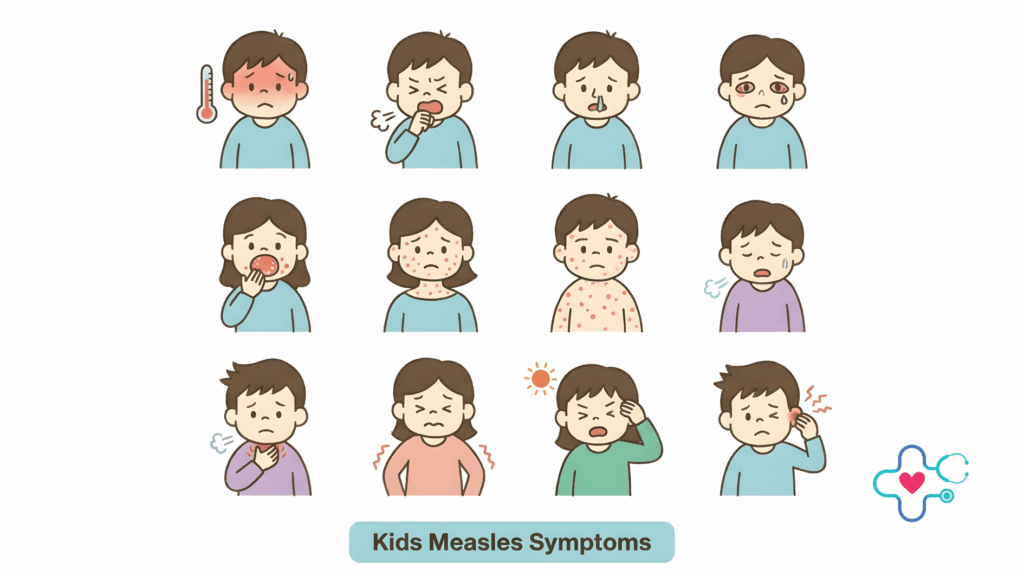
In the early stage, measles often looks like a severe cold or flu. Symptoms may include:
- High fever, often rising quickly
- Cough
- Runny nose
- Red, watery, or irritated eyes
- Fatigue, irritability, or decreased appetite
Because these symptoms are common with many viral illnesses, measles can be difficult to identify at first. A key difference parents often notice is how sick their child looks and feels, especially when fever is high and persistent.
When the Rash Appears
The measles rash typically develops three to five days after fever begins. It usually:
- Starts on the face or hairline
- Spreads downward to the neck, trunk, arms, and legs
- Appears as flat red spots that may merge together
If your child develops fever followed by a spreading rash, or symptoms seem to worsen instead of improve, it’s important to contact a medical provider.
Why Measles Can Be Serious for Children
While many children recover from measles, it is not always a mild illness. Some children are at higher risk for complications, including:
- Infants under 12 months
- Children who are not fully vaccinated
- Children with asthma or chronic medical conditions
- Pregnant individuals and immunocompromised family members
Complications can include ear infections, dehydration, pneumonia, and in rare cases, serious neurologic issues. This is why prompt guidance and careful monitoring are important, even if symptoms seem manageable at first.
How Parents Can Protect Their Children From Measles
MMR Vaccination
The MMR (measles, mumps, rubella) vaccine is the most effective way to prevent measles. Two doses provide strong, long-lasting protection and significantly reduce the risk of severe illness and complications.
If you’re unsure whether your child is up to date on vaccinations or have questions about timing, a pediatric provider can help review your child’s immunization history and answer concerns.
Reducing Exposure
During times of increased measles activity:
- Avoid close contact with anyone who has fever and rash symptoms
- Be cautious in crowded indoor settings when possible
- Notify your healthcare provider if your child may have been exposed
Protecting High-Risk Family Members
If your household includes infants, pregnant individuals, or people with weakened immune systems, extra care is important. Keeping eligible family members vaccinated and limiting exposure to illness helps protect those most vulnerable.
When to Call Before Coming In
Because measles spreads so easily, calling ahead before visiting urgent care is essential.
Please contact a medical provider first if your child has:
- Fever along with a rash
- Known exposure to someone with measles
- Symptoms and is not fully vaccinated
Calling ahead allows our team to prepare appropriately and helps protect other children and families in our care.
Seek urgent or emergency care immediately if your child experiences:
- Trouble breathing or fast, labored breathing
- Extreme sleepiness, confusion, or difficulty staying awake
- Signs of dehydration such as very dry mouth, no tears, or minimal urination
- A very high fever that does not respond to medication
You never have to make these decisions alone. We are always here to help guide you.
For families seeking measles evaluation in Manassas, Night Watch Urgent Care provides walk-in pediatric care without long emergency room wait times.
Our pediatric-trained providers focus on early recognition, safe evaluation, and helping parents understand what to expect next.
CATEGORY
2/12/2026
POSTED
How to Know When Kitchen Injuries Need Professional Care
Your child is helping you cook.
The knife slips. Their finger’s bleeding.
You grab paper towels. Apply pressure. The bleeding slows down.
But when you look at it… it’s deep.
Do they need stitches? Or can you just bandage it?
Here’s how to know.
🔪 Cuts: The Stitches Decision Tree
Come to Night Watch if:
1. The Edges Gape Open
After you release pressure, do the edges pull apart? Can you see inside? Needs stitches.
2. It Won’t Stop Bleeding
After 10 minutes of continuous pressure, still bleeding steadily? Needs evaluation.
3. You Can See Fat, Muscle, or Bone
Needs stitches. Immediately.
4. It’s on Your Face or Hand
Facial cuts risk scarring. Hand cuts risk nerve/tendon damage. Both need professional evaluation.
5. It’s Over a Joint
Knuckles, knees, elbows. Movement pulls edges apart. Needs stitches or special closure.
6. Numbness or Weakness
Can’t feel your finger? Can’t move it normally? Possible nerve or tendon damage. Needs immediate care.
7. Caused by Something Dirty
Rusty knife? Dirty knife? Needs thorough cleaning and tetanus check.
8. It’s Been Hours
Cuts heal best when closed within 6-8 hours. After 12 hours, infection risk increases significantly.
🔥 Burns: First, Second, or Third Degree?
First-Degree Burns (Superficial)
What it looks like:
- Red, painful
- No blisters
- Like a bad sunburn
Treatment: Cool water, aloe, OTC pain relief. Usually okay to treat at home.
Second-Degree Burns (Partial Thickness)
What it looks like:
- Red, very painful
- BLISTERS
- May be wet/weeping
Come to Night Watch if:
- Larger than 3 inches
- On face, hands, feet, joints, or genitals
- Multiple large blisters
- Child or elderly patient
Third-Degree Burns (Full Thickness)
What it looks like:
- White, brown, or charred
- Leathery texture
- May NOT be painful (nerves destroyed)
Action: CALL 911 or go to ER immediately.
⏰ The Time Factor
For Cuts:
→ 0-6 hours: Ideal window for closure. Best healing, lowest infection risk.
→ 6-12 hours: Still can close, infection risk increasing.
→ 12+ hours: Often left open to heal, antibiotics likely needed.
For Burns:
Get evaluated same day. Burn severity isn’t always obvious initially. Infection can develop quickly.
What We Do at Night Watch
For Cuts:
- Thorough cleaning and irrigation
- Assess for nerve, tendon, or arterial damage
- Local anesthesia (numbing injection)
- Closure: Stitches, skin glue, or steri-strips depending on location/depth
- Wound care instructions and follow-up
For Burns:
- Assess burn depth and extent
- Clean and debride if needed
- Apply specialized burn dressings
- Pain management
- Antibiotics if infection risk high
- Refer to burn specialist if severe
Common Mistakes
For Cuts:
- Using super glue or duct tape (not sterile, risks infection)
- Assuming “it’ll be fine” (deep cuts need proper closure)
- Waiting days to seek care (infection sets in)
- Not checking tetanus status
For Burns:
- Putting ice directly on burn (damages tissue further)
- Applying butter, oil, or toothpaste (old wives’ tales, don’t work)
- Popping blisters (infection risk)
- Underestimating severity (“it’s just a little burn”)
🩹 Proper First Aid
For Cuts:
- Apply direct pressure with clean cloth (10 minutes minimum)
- Elevate above heart if possible
- Once bleeding stops, rinse with clean water
- Cover with clean bandage, then seek care if needed
For Burns:
- Remove from heat source immediately
- Cool under running water (not ice) for 10-20 minutes
- Remove jewelry/tight clothing from area
- Cover with clean, dry cloth
- Seek medical care if criteria met
The Bottom Line
→ When in doubt, come in. Better to have it checked.
→ Time matters. Don’t wait days.
→ Deep cuts need professional closure.
→ Second-degree burns need evaluation.
→ Face and hand injuries always get checked.
🔪 “Does this need stitches?” We can tell you for sure.
Get it checked before it gets infected.
CATEGORY
1/31/2026
POSTED
How to Tell the Difference (And When to Worry)
You’ve been staring at screens all day.
Now your head hurts.
Is it just digital eye strain? Or something more serious?
Let’s break it down.
📱 Digital Eye Strain Headaches
What It Feels Like:
- Dull ache across forehead or temples
- Pressure behind eyes
- Starts gradually after screen use
- Gets worse the longer you’re on screens
- Improves when you take breaks
Other Symptoms:
- Dry, irritated eyes
- Blurry vision
- Neck and shoulder tension
- Light sensitivity
Treatment:
Take screen breaks, use 20-20-20 rule, artificial tears, better ergonomics. Usually resolves on its own.
Migraine Headaches
What It Feels Like:
- Intense, throbbing pain (often one-sided)
- Can be triggered by screens but feels different
- Moderate to severe intensity
- Lasts 4 – 72 hours if untreated
- Gets worse with physical activity
Other Symptoms:
- Nausea or vomiting
- Extreme light and sound sensitivity
- Visual disturbances (aura) before headache
- Need to lie down in dark, quiet room
Treatment:
Migraine medications, dark room, rest. May need prescription treatment if frequent.
💢 Tension Headaches
What It Feels Like:
- Band-like tightness around head
- Both sides of head affected
- Mild to moderate pain
- Related to stress, poor posture, or muscle tension
Screen-Related Cause:
Hunching over devices → neck strain → tension headache. Very common with prolonged screen use.
When It’s NOT Just Screen Time
Come to Night Watch immediately if:
- Worst headache of your life (“thunderclap headache”)
- Headache with fever, stiff neck, or confusion
- Vision loss or double vision
- Sudden onset after head injury
- Weakness, numbness, or difficulty speaking
- Headache that wakes you from sleep
- New headache pattern in someone over 50
These could indicate serious conditions requiring immediate evaluation.
Vision Problems vs. Eye Strain
Digital Eye Strain:
- Temporary blurry vision that clears with breaks
- Improves when not using screens
- Both eyes affected similarly
Actual Vision Problems:
- Persistent blurry vision
- Double vision
- Halos around lights
- One eye affected more than other
- Sudden vision changes
If vision problems persist after screen breaks, you need an eye exam.
What We Do at Night Watch
When you come in with headaches or vision concerns:
- Detailed history (headache pattern, triggers, associated symptoms)
- Physical and neurological exam
- Visual screening
- Rule out serious causes (infections, neurological issues)
- Provide treatment (pain relief, migraine meds if appropriate)
- Refer to specialists (ophthalmology, neurology) if needed
Prevention Strategies
For Screen-Related Headaches:
- 20-20-20 rule (every 20 min, look 20 feet away for 20 sec)
- Proper ergonomics (screen position, chair height, lighting)
- Blue light filters (especially evening)
- Adequate breaks (get up, move around)
- Adjust screen brightness (match room lighting)
For Migraines:
- Identify and avoid triggers
- Consistent sleep schedule
- Hydration
- Stress management
- Consider preventive medications if frequent
The Bottom Line
→ Most screen-related headaches are eye strain or tension headaches
→ They improve with breaks and better habits
→ Migraines are more severe and come with other symptoms
→ Sudden, severe, or unusual headaches need evaluation
→ When in doubt, get it checked
🤕 Screen headache or something more serious? We can help you figure it out.
CATEGORY
1/29/2026
POSTED
When Should You Actually Test Their Immune System?
Your child has been sick seven times since September.
You’re keeping a tally. You’ve used all your sick days. You’re starting to wonder if something is actually wrong.
Should you ask for immune testing?
Let’s walk through this.
What is “Immune Deficiency”?
Primary immunodeficiency disorders (PIDDs) are genetic conditions where the immune system doesn’t work properly.
How common are they?
Rare. About 1 in 1,200 people. Most are diagnosed in childhood.
Translation: If your child gets lots of colds, it’s probably not an immune deficiency. But if they meet certain criteria, testing might be warranted.
The “10 Warning Signs”
The Jeffrey Modell Foundation (experts in immune deficiency) lists 10 warning signs:
- 1. 4+ new ear infections in one year
- 2. 2+ serious sinus infections in one year
- 3. 2+ months on antibiotics with little effect
- 4. 2+ pneumonias in one year
- 5. Failure to gain weight or grow normally
- 6. Recurrent deep skin or organ abscesses
- 7. Persistent thrush or fungal infections
- 8. Need for IV antibiotics to clear infections
- 9. 2+ deep-seated infections (meningitis, sepsis, bone infection)
- 10. Family history of primary immunodeficiency
Notice what’s NOT on this list:
“Lots of colds.”
Normal vs. Concerning
✅ PROBABLY NORMAL
- 6 -12 colds per year
- 2-3 stomach bugs per year
- Occasional ear infections that respond to antibiotics
- Pink eye once or twice
- Hand-foot-mouth disease, croup, etc.
⚠️ POTENTIALLY CONCERNING
- Multiple pneumonias
- Recurrent sinus infections requiring antibiotics
- Ear infections that don’t respond to treatment
- Deep infections (blood, bone, organs)
- Chronic diarrhea + poor growth
- Unusual infections (fungal, atypical bacteria)
It’s the TYPE and SEVERITY of infections that matter, not just the frequency.
What Immune Testing Involves
If testing is warranted, we typically start with:
Complete Blood Count (CBC)
Checks overall white blood cell counts and types
Immunoglobulin Levels
Measures antibody levels (IgG, IgA, IgM, IgE)
Vaccine Response Testing
Checks if body made antibodies to vaccines they’ve received
More specialized testing (genetic testing, T-cell function, etc.) is done by immunology specialists if initial tests are concerning.
How We Help at Night Watch
When you bring your frequently-sick child to us:
- Review their illness history
- Diagnose current illness (strep, flu, ear infection, etc.)
- Evaluate patterns (are these serious infections or common colds?)
- Order initial testing if warranted (CBC, immunoglobulins)
- Refer to immunology specialists if testing suggests immune deficiency
- Reassure you when it’s normal childhood illness
📝 What to Track
Keep a log if you’re concerned:
- Date and type of each illness
- Whether antibiotics were needed
- How well they responded to treatment
- Any hospitalizations or ER visits
- Growth patterns (height/weight)
Bring this to your visit. It helps us see the big picture.
The Bottom Line
→ Most kids who get sick frequently have normal immune systems
→ 6 -12 illnesses per year is textbook normal for young children
→ It’s the severity and type of infections that matter, not just frequency
→ True immune deficiency is rare
→ If you meet warning criteria, testing is appropriate
🤧 Worried about recurrent illness? We can evaluate.
Most of the time, it’s normal. But we’ll help you know for sure.
CATEGORY
1/22/2026
POSTED
How to Tell—and What to Do About It
Your eyes are red. They’re itchy. There’s goop in the corners.
You Google: “red itchy eye” and everything says pink eye.
But is it really pink eye? And does it even need treatment?
Here’s what you need to know.
Not All Red Eyes Are Pink Eye
“Pink eye” (conjunctivitis) is inflammation of the conjunctiva – the clear membrane covering the white part of your eye.
But red eyes can also be:
- Dry eyes (from screen time, dry air, aging)
- Stye (infected eyelash follicle – bump on eyelid)
- Subconjunctival hemorrhage (broken blood vessel – bright red patch, not painful)
- Corneal abrasion (scratch on eye surface – painful)
- Foreign object (something in your eye)
How to tell if it’s actually pink eye:
- Discharge – Pink eye produces discharge. Dry eyes don’t.
- Crusting – Waking up with eyes sealed shut = pink eye
- Contagious spread – If others around you are getting it, likely pink eye
👀 The Three Types—How to Tell Them Apart
VIRAL Pink Eye
Symptoms:
- Watery, clear discharge
- Very itchy, very red
- Usually starts in one eye, spreads to other within 1-2 days
- Often accompanies cold symptoms
Caused by:
Adenovirus (same family as common cold)
Contagious?
EXTREMELY. Can spread for up to 2 weeks.
Treatment:
No antibiotics (it’s a virus). Supportive care—cool compresses, artificial tears. Runs its course in 7-14 days.
BACTERIAL Pink Eye
Symptoms:
- Thick, yellow or green discharge
- Eyes glued shut with crusty goop in morning
- More painful than viral
- Can affect one or both eyes
Caused by:
Bacteria (Staph, Strep, Haemophilus)
Contagious?
Yes, until treated with antibiotics.
Treatment:
Antibiotic eye drops. Usually clears in 3-5 days. Contagious until 24 hours after starting drops.
ALLERGIC Pink Eye
Symptoms:
- Both eyes affected at same time
- VERY itchy
- Watery discharge
- Other allergy symptoms (sneezing, runny nose)
Caused by:
Allergens (pollen, dust, pet dander, mold)
Contagious?
No.
Treatment:
Antihistamine eye drops, avoid allergen. Usually improves quickly.
When You Need to Come In
- Thick, colored discharge (likely bacterial = needs antibiotics)
- Eye pain or vision changes
- Sensitivity to light
- You wear contact lenses (higher infection risk)
- Symptoms not improving after 3-4 days
- You need a work note
- Newborn or infant with pink eye (always needs evaluation)
What We Do at Night Watch
- Examine eyes to determine type
- Rule out other causes (corneal abrasion, foreign object, etc.)
- Prescribe treatment (antibiotic drops for bacterial, supportive care for viral, antihistamines for allergic)
- Provide work/school notes
- Educate on preventing spread
🧼 Preventing Pink Eye
- Wash hands frequently – especially before touching eyes
- Don’t touch or rub eyes
- Don’t share towels, pillows, eye makeup, contact lens cases
- Replace eye makeup every 3 months, immediately after pink eye
- Clean contact lenses properly or use daily disposables
- Disinfect shared surfaces if someone in household has pink eye
❌ Common Mistakes
- Using old antibiotic drops from last time – they may be expired or contaminated
- Stopping antibiotics early – finish entire course
- Sharing drops between family members – spreads infection
- Wearing contacts during infection – can worsen and prolong infection
- Going to work/school before cleared – spreads to others
👁️ Red eyes? Goopy discharge? We can tell you what it is. Get the right diagnosis. Get the right treatment.
CATEGORY
1/20/2026
POSTED
Could Be Spraying Bacteria Into Their Face All Night
Let’s talk about your humidifier.
When’s the last time you cleaned it? Really cleaned it?
Not rinsed. Not “emptied the water.” Actually scrubbed, disinfected, and dried it?
If you’re thinking “…uh… never?” you’re not alone.
But here’s what’s happening inside that thing.
🦠 The Petri Dish in Your Kid’s Bedroom
A humidifier is basically a warm, wet, dark container.
Perfect environment for:
- Bacteria to multiply
- Mold to grow
- Biofilm to form (that slimy coating you can’t quite scrub off)
Within 24-48 hours of filling it with water, bacterial colonies start forming.
By day 3-4? Full-on bacterial party.
And every time you turn it on, it aerosolizes that bacteria-filled water and sprays it into the air your child breathes.
🔬 What Research Has Found
Studies analyzing home humidifiers found:
Legionella (Legionnaires’ Disease Bacteria)
Found in up to 32% of tested humidifiers. Causes severe pneumonia. Can be fatal in vulnerable populations.
Pseudomonas Aeruginosa
Common in hospital-acquired infections. Found frequently in home humidifiers. Causes respiratory infections, especially in people with compromised immune systems or chronic lung conditions.
Mold Spores (Aspergillus, Penicillium, Cladosporium)
Triggers asthma attacks, allergic reactions, and respiratory infections. Some molds produce mycotoxins (toxic compounds).
Endotoxins
Inflammatory compounds from bacterial cell walls. Cause fever, flu-like symptoms, and lung inflammation.
Mineral Deposits (“White Dust”)
From tap water minerals. Fine particles that settle on surfaces AND get inhaled. Can irritate lungs, especially in children with asthma.
“Humidifier Fever” & “Humidifier Lung”
These are real medical conditions:
Humidifier Fever (Endotoxin-Induced)
Symptoms:
- Fever and chills
- Body aches
- Headache
- Cough
Hypersensitivity Pneumonitis (“Humidifier Lung”)
Symptoms:
- Shortness of breath
- Persistent dry cough
- Chest tightness
- Fatigue
- Can cause permanent lung damage if exposure continues
The clue? Symptoms worsen at night (when humidifier runs) and improve during the day or away from home.
When to Come to Night Watch
- Persistent cough (especially worse at night)
- Wheezing or shortness of breath
- Chest tightness or pain
- Fever with respiratory symptoms
- Symptoms that improve away from home
- Recurring respiratory infections
We can evaluate for infections, provide breathing treatments, and help identify environmental triggers.
🧼 The REAL Cleaning Protocol
Most people don’t clean humidifiers nearly enough. Here’s what actually works:
EVERY DAY
- Empty ALL water (tank AND base)
- Rinse with clean water
- Wipe dry with clean towel
EVERY 3 DAYS
- Fill with undiluted white vinegar
- Let sit 30 minutes
- Scrub all surfaces with soft brush
- Rinse thoroughly until vinegar smell is gone
WEEKLY
- Disinfect with 3% hydrogen peroxide (fill tank, let sit 30 min)
- OR use diluted bleach (1 teaspoon per gallon water, 10 min soak)
- Rinse thoroughly multiple times (zero chemical residue)
ALWAYS
- Use ONLY distilled or demineralized water
- Replace filters per manufacturer schedule
- If you see/smell mold, throw it out and start fresh
Signs Your Humidifier Is Beyond Saving
- Black or green mold visible anywhere
- Persistent musty/moldy smell even after cleaning
- Thick biofilm that won’t scrub off
- Heavy mineral buildup that can’t be removed
- You literally can’t remember when you last cleaned it
If any of these apply? Throw it out. Buy a new one. Start fresh.
Better Alternatives
- Warm mist humidifiers: Boil water first, killing bacteria before releasing steam
- UV light models: Kill microorganisms before misting
- Low-tech options: Bowl of water on radiator, wet towels, houseplants
- Target 30-50% humidity: Higher than this promotes mold growth in your home
💧 You bought a humidifier to help. Don’t let it become the problem.
CATEGORY
1/16/2026
POSTED
Three Family Members at Urgent Care.
The new puppy has been home for one week.
Your daughter has scratches up and down her arms. Your son has a bite mark on his hand that’s looking puffy and red. And you? You’ve got a puncture wound from breaking up their “tug of war” that the puppy thought included your fingers.
Nobody told you this part of pet ownership.
Why Animal Bites Get Infected So Easily
Here’s the truth: animal mouths are bacteria factories.
Dogs, cats, puppies, kittens – their saliva contains dozens of types of bacteria. When they bite or lick an open wound, those bacteria get pushed deep into your tissue.
The result? Infection. And animal bite infections can get serious fast.
Infection rates by animal:
- Cat bites: 30-50% infection rate (high!)
- Dog bites: 10-20% infection rate
- Human bites: Actually the highest risk—but that’s another blog
Signs of Infection You Can’t Ignore
Come to Night Watch immediately if the bite or scratch shows:
- Redness spreading from the wound
- Red streaks going up the arm or leg
- Swelling, warmth, or increased pain
- Pus or drainage from the wound
- Fever
- Difficulty moving the affected area
- Swollen lymph nodes
These are signs your body is fighting an infection – and may be losing.
⏰ Time Matters
Here’s what people don’t realize: the sooner you get treatment, the better.
Within 8 hours of injury: Wound can be thoroughly cleaned, greatly reducing infection risk. May be able to close with stitches.
After 8 hours: Infection risk increases. May need to leave wound open. Antibiotics almost always needed.
After 24+ hours: If untreated, infection may have already started. Requires aggressive treatment.
Don’t wait. Come in the same day you’re bitten.
🐾 High-Risk Bites
Some bites are higher risk than others:
Hand Bites
Highest infection risk. Lots of small spaces for bacteria to hide. Close to tendons, joints, and bones. Always need medical evaluation.
Face Bites
Risk of scarring, nerve damage, and infection. Need immediate care.
Puncture Wounds
Look small on the surface but push bacteria deep into tissue. High infection risk. Often from cat bites.
Bites Through to Bone/Joint
Can cause bone or joint infection (osteomyelitis, septic arthritis). Serious. Need immediate treatment.
Treatment at Night Watch
We treat animal bites and scratches for all ages:
- Thorough wound irrigation (high-pressure cleaning to flush out bacteria)
- Examination for deep tissue damage
- X-rays if needed (to check for bone involvement)
- Stitches or wound closure (depending on type/location)
- Preventive antibiotics (especially for high-risk bites)
Preventing the Next Bite
- Supervise all pet interactions with children
- Start training immediately (puppy classes, bite inhibition)
- Don’t let pets mouth or play-bite people
- Keep kitten nails trimmed
- Redirect biting to appropriate toys
- Teach children to respect pet boundaries
New pets are adorable, infected animal bites are not. Get it treated before it gets serious.
CATEGORY
1/13/2026
POSTED
“They’re just a teenager. Teenagers are tired.”
That’s what you’ve been telling yourself for weeks. Maybe months.
But deep down, you know this is different. This isn’t “stayed up too late scrolling TikTok” tired. This is “can barely function” tired.
So what’s actually going on?
🔬 The Power of Testing
Here’s what many parents don’t realize: extreme exhaustion in teens almost always has a medical cause, and most of them are diagnosable with simple blood work.
🩸 What We Test For
1. Mononucleosis (Mono)
The Test: Monospot test (quick, simple blood test)
What It Shows: Whether they have active Epstein-Barr virus infection
Why It Matters: Mono causes weeks of extreme fatigue. Knowing they have it means they can rest properly and avoid complications (like enlarged spleen rupture from sports).
2. Complete Blood Count (CBC)
The Test: Basic blood work checking red/white blood cells
What It Shows: Anemia (low iron), infections, blood disorders
Why It Matters: Anemia is incredibly common in teenage girls and causes crushing fatigue. Treatment is simple – iron supplements, but you need to know it’s there first.
3. Thyroid Panel (TSH, T3, T4)
The Test: Blood test measuring thyroid hormone levels
What It Shows: Whether thyroid is underactive (hypothyroidism) or overactive (hyperthyroidism)
Why It Matters: Thyroid problems are surprisingly common in teens and cause fatigue, weight changes, mood issues, brain fog. Highly treatable with medication.
4. Vitamin Deficiencies (D, B12, etc.)
The Test: Blood work checking vitamin levels
What It Shows: Whether they’re deficient in key nutrients
Why It Matters: Vitamin D deficiency causes fatigue, depression, weakened immune system. B12 deficiency causes exhaustion and cognitive issues. Easy to fix with supplements.
🏥 What Happens at Your Visit
Here’s what to expect when you bring your teen to Night Watch:
- Walk in—no appointment needed
- Complete medical history (symptoms, duration, other concerns)
- Physical examination (checking for swollen lymph nodes, pale skin, other signs)
- Blood work (depending on symptoms—often CBC, mono test, thyroid panel)
- Results & treatment plan (many tests give results same-day)
- Referrals if needed (to specialists for further care)
⏰ When to Come In
Stop waiting for it to “get better on its own.” Come in if:
- Exhaustion has lasted more than 2 weeks
- It’s interfering with school, activities, or social life
- They’re sleeping 10+ hours and still tired
- Other symptoms are present (sore throat, weight changes, mood changes)
- You’ve tried better sleep hygiene and nothing’s improving
You can’t fix what you can’t diagnose. Let’s find out what’s really going on.
CATEGORY
1/09/2026
POSTED
When Holiday Leftovers Turn Into a Family Health Crisis
You hosted the holiday gathering. The food was delicious. Everyone had seconds. Some people took leftovers home.
Now it’s three days later and your phone is blowing up:
“Hey, I’ve been throwing up since yesterday…”
“My kids are sick too…”
“Did anyone else get food poisoning from dinner?”
Uh oh.
When One Meal Takes Down Multiple People
Food poisoning doesn’t always happen because food was “old.” Sometimes it happens because:
- Food wasn’t cooked to the right temperature (undercooked poultry, stuffing)
- Food sat out too long (buffet style for 3+ hours)
- Cross-contamination happened (raw meat juice on veggies)
- Someone sick was handling food (norovirus spreads easily)
- Leftovers weren’t refrigerated quickly enough
If multiple people from the same meal get sick, it’s likely something at that dinner was contaminated.
Food Poisoning vs. Stomach Flu
Wait—how do you know it’s food poisoning and not just a stomach bug going around?
FOOD POISONING:
- Symptoms start suddenly (often within hours of eating)
- Everyone who ate the same thing gets sick
- Usually resolves in 24-48 hours
STOMACH FLU (NOROVIRUS):
- Spreads person-to-person over days
- Can be passed even without eating together
- Often includes fever and body aches
Either way? If symptoms are severe, come see us.
When to Seek Urgent Care
For Children:
- 🤢 Vomiting for more than 12 hours
- 💧 Can’t keep any liquids down
- 😴 Extreme lethargy or confusion
- 🚽 No wet diapers in 6+ hours
What We Can Do
At Night Watch, we treat food poisoning in children:
- IV fluids for rapid rehydration
- Anti-nausea and anti-diarrheal medications
- Stool testing to identify the bacteria
- Antibiotics (if bacterial infection is confirmed)
- Guidance on recovery and when to follow up
Prevention Tips for Next Time
- Use a meat thermometer: 165°F for poultry, 145°F for most other meats
- Don’t leave food out: Refrigerate within 2 hours (1 hour if it’s hot outside)
- Separate raw and cooked: Use different cutting boards and utensils
- Wash hands thoroughly: Before and after handling food
- When in doubt, throw it out: If it smells off or you can’t remember when you cooked it, toss it
CATEGORY
1/06/2026